
June 9, 2026
- State and local incentives for large-scale clean energy projects are expected to pay off for state residents for over two-thirds of projects examined, according to an Upjohn Institute report that is the most comprehensive multi-state study ever done of major incentive projects.
- Some clean energy incentives were structured such that they have higher costs than benefits; however, reforms to state incentive policies can significantly increase their net benefits for state residents’ incomes.
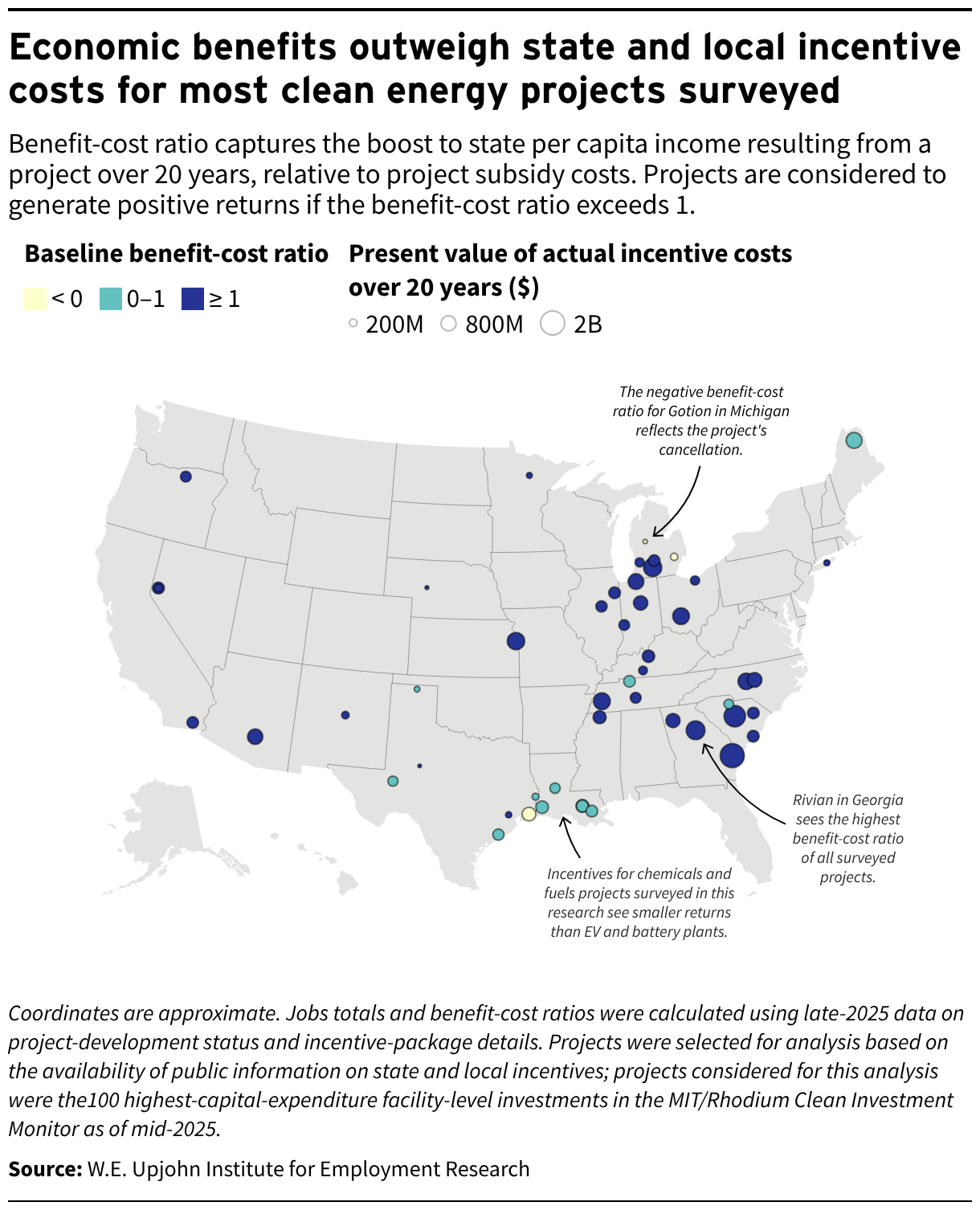
State and local incentives for clean energy manufacturing and infrastructure projects are expected in most cases—70 percent of projects—to generate positive economic returns for state residents. Whether and how much state residents benefit, however, depends greatly on how incentive deals are designed and targeted. That conclusion comes from a new report by the W.E. Upjohn Institute for Employment Research, based on examining 50 of the largest clean energy projects, which collectively promise over 95,000 jobs and are being offered almost $30 billion in state and local incentives. The Upjohn report also lays out how policymakers can reform incentive policies to improve benefits for state residents.
Key findings from the study include:
- Most projects studied for the report — 35 of 50 — are projected to generate benefits that exceed costs. The median clean-energy project has a benefit-cost ratio of 1.47, meaning the estimated increase in state per-capita income is 47% greater than the taxpayer cost of the incentives.
- Electric vehicle (EV) and battery manufacturing see a stronger return on investment than other project types surveyed. For EV/battery projects, the median net benefit, or benefit-cost ratio, is 2.34, meaning the estimated increase in state per-capita income is 134% greater than the taxpayer cost of the incentives. For other projects, including wind and solar farms and clean fuels facilities, the benefit-cost ratio is 0.83. That means the income gain for state residents is 17% less than the taxes paid to fund the incentives. This reason for the difference is driven by jobs. EV and battery projects tend to create many jobs while some other projects create relatively few direct jobs but still receive high incentives. This makes it difficult for those projects to pay off by traditional economic development measures, but those metrics do not account for benefits to local air quality, electricity prices, or supply-chain development.
- These 50 projects have attracted lucrative incentives, which raised the price tag, but also increased these projects’ “but for” – the percentage of projects that would not have been located in the chosen state “but for” the provision of incentives. Collectively, these 50 projects have promised to create over 95,000 jobs and have been offered almost $29 billion in incentives over the project’s lifetime, with most incentives payable in a project’s first 20 years. These incentives per job, of over $300,000, result in the incentives being successful in inducing many location decisions. For the median project, the study finds a 78 percent “but for” – there is a 78 percent chance that the project would not have occurred in its location without the incentive. The price tag for these 50 projects implies an even larger national total.
- Projects located in the South see a higher benefit-cost ratio than surveyed projects located elsewhere. The Upjohn Institute attributes this difference to two factors: many of the projects in the South are located in economically distressed counties; and the region generally makes it easier to build new housing, which ensures that community infrastructure can keep up with new economic growth.
- Delivering incentives as specialized services, as opposed to cash, improves the cost effectiveness of incentives by 50 percent. Customized services like workforce training or infrastructure improvements increase benefits, while large incentive packages show diminishing returns. This shows that returns on incentives vary not just by industry and location, but also by size and format.
- Bigger incentive packages do not always produce better outcomes. While massive packages drive up the likelihood of landing a project, throwing too much cash at a single deal yields diminishing returns. The 10 projects with the highest ratios of incentives to jobs all have benefit-cost ratios less than one.
- The net economic benefits of the incentives for these projects disproportionately benefit lower-income groups. All income groups benefit, but the bottom three-fifths of the population (low- to middle-income groups, the bottom three income quintiles) see net income gains that are proportionally about twice as large as their baseline share of income.
- Economic returns on incentives depend on a state’s preexisting supply chain. Because the boost to state residents’ earnings and income depends heavily on a project’s overall effects on job creation, it matters how much a project’s direct jobs lead to “multiplier” jobs in the state economy, such as potential local suppliers to the project. States whose history or policies have created a stronger supply chain for clean energy can expect to see higher economic returns from incentives for clean energy projects. If job multipliers are higher by one-third, benefit-cost ratios increase by at least one-third.
- Targeting distressed places yields higher returns for state residents. In distressed places, a higher proportion of the jobs created are likely to go to local residents who are not currently employed, boosting local employment rates and per-capita incomes. In contrast, in booming places, job creation leads to more relocation, which puts more upward pressure on local prices and requires increased public spending. Targeting a distressed place, compared to an average place, will increase benefit-cost ratios by 50 percent.
- Accommodating growth with increased housing supply boosts project returns. Job creation leads to population growth. If little housing supply is built to accommodate population growth, housing prices increase. While this provides property owners with capital gains, such gains are entirely offset by increased costs for residents who rely on Social Security or other income sources that do not rise with the state economy. In addition, higher local costs tend to discourage the growth of other jobs, reducing a project’s net job creation effects. In local areas with more restrictions on housing supply, benefit-cost ratios are reduced by 30 percent.
- More complete and enforced clawbacks matter. In cases where a project is canceled, the net losses from incented projects can be significantly reduced if governments not only reduce future incentives but also recover a significant proportion of any upfront incentives.
- Policymakers can improve the return on incentives through several types of reform. These reforms include avoiding excessive ratios of tax incentives to project jobs, targeting more projects in distressed places, and targeting and designing projects so that they are more connected to local supply chains and have higher job multipliers. They also include switching the mix of incentives from tax incentives to more emphasis on customized job training and infrastructure assistance to firms, making sure that local housing policies accommodate growth, and incorporating and enforcing clawback agreements if incented projects are closed or cut back.
"Clean energy incentives can be a good investment for communities, but there are reasons some are more likely to pay off,” said Tim Bartik, senior economist, Upjohn Institute. "The strongest deals are not simply the biggest deals. They are the ones that create substantial jobs, keep incentive costs reasonable, target communities where new employment will matter most and where growth is accommodated, and include strong safeguards for taxpayers.”
Bartik also notes that clean energy projects bring benefits beyond the traditional measures of economic development, including lower emissions, cleaner air, and stronger domestic supply chains. But even when those broader goals are part of the rationale, states and localities should design incentives with discipline, transparency, and accountability.
The study was conducted in partnership with RMI, an independent, nonpartisan nonprofit founded in 1982 that transforms global energy systems through market-driven solutions to secure a prosperous, resilient, clean energy future for all.
“As state and local leaders continue to compete for manufacturing investment in new energy technology, they need to know how to make the most of the tools and resources available to them,” said Aaron Brickman, senior principal, Economic Development, RMI. “The Upjohn Institute’s research shows that well-designed development subsidies for new energy projects, particularly in manufacturing, can yield economic benefit. State and local leaders can squeeze more out of every dollar by ensuring they can provide specialized support for new projects such as workforce development and by ensuring that the projects they target play to their economic strengths.”
About the Report
The 50 large-scale projects examined by the Upjohn Institute include electric vehicle battery plants, hydrogen facilities, wind and solar projects, and other clean-energy supply-chain investments. The projects were chosen from the 100 largest recent clean energy investments, based solely on whether sufficient project information was available on state and local incentives provided. The incentives studied include property tax abatements; job creation tax credits; investment credits; deal-closing grants; customized job training and worker recruitment programs; and access roads and other infrastructure.
Using the Bartik Benefit-Cost Model of Business Incentives, the report estimates how government incentives for such projects affect residents’ real per capita income over a 20-year horizon. Most of these benefits are due to project job creation leading to higher per capita earnings for state residents. Not included in the report are other possible benefits or costs for clean energy projects due to environmental benefits and costs, and possible effects for some projects on energy costs.
The report is the most comprehensive, multi-state and multi-program report ever done on economic development incentives for major business projects.
The full report, “The Economic Benefits and Costs of State and Local Incentives for Clean Energy Projects,” is available at: https://research.upjohn.org/up_technicalreports/57/
Experts


