
July 31, 2026
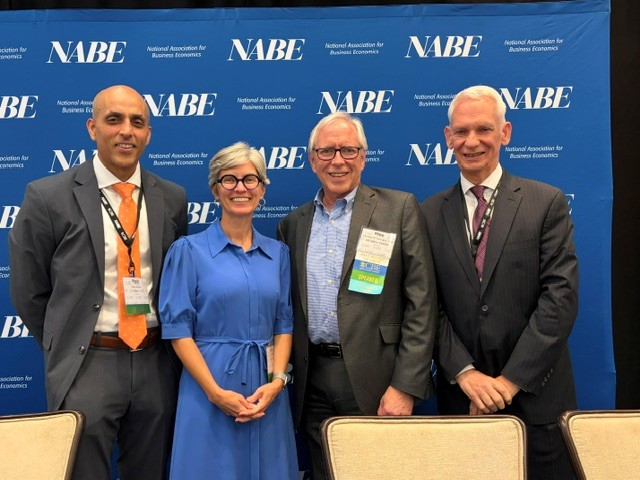
Upjohn Institute President Michael Horrigan recently served as a moderator at the National Association for Business Economics (NABE) Foundation's 23rd Annual Economic Measurement Seminar in Washington, D.C., leading three discussions focused on key issues in economic measurement and public policy.
One featured session, "Behind the Numbers: How U.S. Statistical Agencies Innovate and Adapt," brought together leaders from the nation's principal federal statistical agencies, including Vipin Arora, director of the U.S. Bureau of Economic Analysis; Deirdre Dalpiaz Bishop, principal associate director of the U.S. Census Bureau; and William Wiatrowski, deputy commissioner of the U.S. Bureau of Labor Statistics.
The panel examined how federal statistical agencies are modernizing the ways they collect, analyze, and share economic data to better meet the needs of policymakers, businesses, researchers, and the public. Discussion topics included new approaches to data collection, the importance of collaboration across agencies, and the role of transparency and public trust in maintaining the quality and integrity of official statistics.
The conversation underscored the critical role federal statistical agencies play in producing reliable, timely data that informs economic research and supports sound decision-making across the public and private sectors.
In addition to that discussion, Horrigan moderated two sessions focused on key measures of the U.S. economy. "Unemployment and Labor Force Indicators" explored trends and measurement issues related to labor market statistics and featured Nic Johnson of the U.S. Bureau of Labor Statistics and Nicol Nicola of the New Jersey Department of Labor and Workforce Development. He also moderated "The Price Pipeline: Producer and Import/Export Prices," featuring Susan Fleck and Robert LaJeunesse of the U.S. Bureau of Labor Statistics, which examined the economic indicators used to track inflation and price changes throughout the economy.