October 30, 2025
A new analysis by the W.E. Upjohn Institute for Employment Research finds that the Rx Kids program delivers measurable economic benefits to families and the broader local economy in Flint, Michigan.
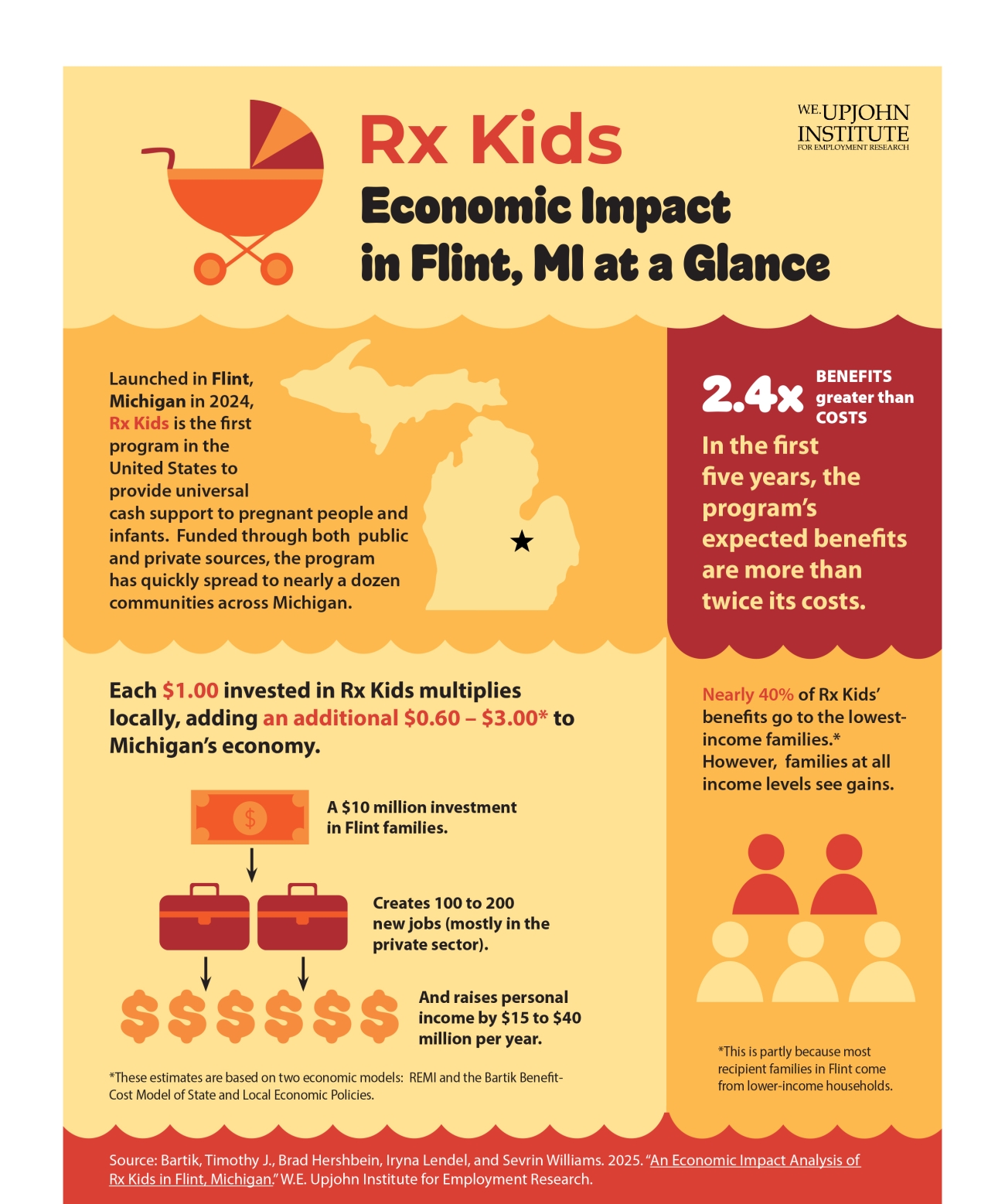
Launched in 2024, Rx Kids is the first community-wide prenatal and infant cash program. The program, which is both publicly and privately funded, provides $1,500 during pregnancy and $500 per month for babies for 6-12 months. According to the new analysis of the first Rx Kids community, Rx Kids in Flint is expected to add between 100 and 200 jobs in Michigan annually and generate between $15 million and $40 million in additional personal income per year, with most of the impact concentrated in Flint and Genesee County.
“Rx Kids is not only supporting families at a critical time. It is also giving the Flint economy a measurable boost,” said Brad Hershbein, senior economist at the Upjohn Institute and one of the study’s authors. “It is an example of how a program designed to improve public health can also produce economic benefits for the community.”
Strong economic return
The report estimates the economic effects of Rx Kids in Flint are between 60 and 300 percent higher than the direct spending to families with new children. For every dollar invested in these families, Rx Kids contributes an additional 60 cents to $3 to the state economy, with most of those dollars circulating locally.
Using two separate economic models, researchers found the program increases household spending, creating jobs in retail trade, construction, real estate, social assistance, and local government. Disposable personal income is projected to increase by roughly $15 million annually over the first five years.
By boosting family financial security, we’re not only supporting healthier moms and babies—we’re fueling job growth and economic activity across entire communities,” said Dr. Mona Hanna, director of Rx Kids and associate dean of public health at the MSU College of Human Medicine. “The findings from the Upjohn Institute provide rigorous evidence to demonstrate that this kind of investment has a powerful multiplier effect, which extends far beyond the impact to any one family.”
Benefits reach Flint’s lowest-income families
While Rx Kids benefits are distributed broadly, they are especially concentrated among low-income households. Nearly two-fifths of the gains go to families in the lowest fifth of Michigan’s income distribution. Flint, the first community to adopt Rx Kids, has a poverty rate of about 34 percent, two and a half times the state average. Families use Rx Kids payments to cover essential needs like rent, utilities, food, transportation, and healthcare.
Economic benefits exceed program costs
The analysis finds Rx Kids raises per capita income by as much as 2.4 times the program’s costs, reflecting both direct transfers to families and indirect economic gains from job creation, higher wages, and increased tax revenue. The findings suggest that Rx Kids is not only providing critical support to families with infants but also strengthening the Flint-area economy.
About Rx Kids
Rx Kids is a program of the Michigan State University Pediatric Public Health Initiative, in collaboration with Poverty Solutions at the University of Michigan, administered by the nonprofit organization GiveDirectly. The structure of the program is simple:
- Recipients must be residents of a participating Michigan community.
- Individuals who have reached 16 weeks of pregnancy can receive a one-time cash transfer of $1,500 after applying for the program.
- Following the baby’s birth, families receive $500 per month for six or twelve months, depending on the community.
- The program is unconditional; there are no income limits or work requirements to qualify, which keeps the program streamlined and cost-efficient to administer.
- Payments are not subject to income tax and do not affect eligibility for other public benefits.
The analysis from the Upjohn Institute examined the impact of the Flint program, the first community to implement Rx Kids. The program has expanded to also serve families in Kalamazoo, the Eastern Upper Peninsula, Pontiac, Clare County, Royal Oak Township, and Hazel Park. Moreover, Michigan’s recently passed 2026 budget includes $270 million toward future expansion of the program.
About the Upjohn Institute
The Upjohn Institute for Employment Research is a nonprofit, nonpartisan organization. Since 1945, the Institute has conducted research on labor markets, workforce issues, and economic development policies, sharing insights from its research to inform policy and practice at the national, state, and local levels.
Timothy Bartik, Brad Hershbein, Iryna Lendel, and Sevrin Williams are the Upjohn researchers who authored the analysis.
Experts


