
October 14, 2026
State and local governments spend about $95 billion each year trying to attract businesses. The money is largely used on incentives like tax credits, grants, and other forms of cash-based assistance.
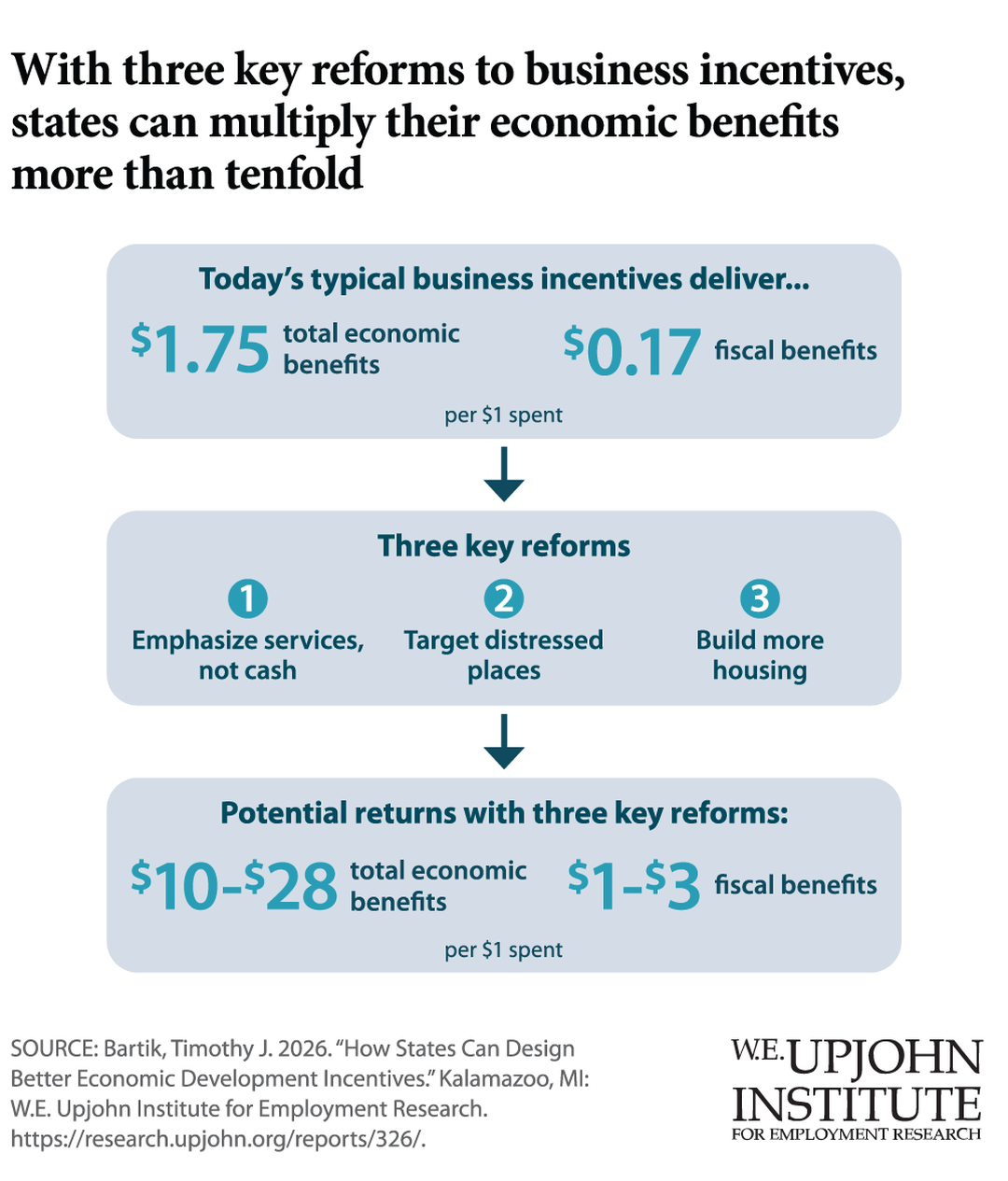
The problem? Economic modeling shows that most incentive programs don’t provide good value for the money states are spending. For each $1.00 spent, cash-driven programs return about $1.75 in total economic benefits but only $0.17 in “fiscal benefits” (the net tax revenue for states, after accounting for new public service costs).
The question of how states spend their money is more important than ever. Federal aid to states has come under threat in recent years. State and local governments are facing major budget gaps. Unlike the federal government, states have to balance their budgets. An incentive that doesn’t pay for itself is money that has to come from somewhere else.
In new research published with support from the Rockefeller Foundation, Upjohn Institute Senior Economist Timothy J. Bartik models state economic development policies—and finds that there’s a much better way to design them. Bartik finds that by moving away from cash-based incentives and instead favoring three key policy approaches, states can exponentially increase the value of their incentives, both for state governments and for individuals.
The three approaches are 1) provide businesses with services instead of cash, 2) target distressed places, and 3) build more housing. By focusing on these policies, states can get much more bang for their buck.
Provide services, not cash
States currently spend roughly $0.85 of every incentive dollar on cash programs like grants and tax rebates. Less than $0.15 is spent on providing businesses with customized services. That ratio is backwards. What businesses really need most often is access to trained workers and ready-to-use infrastructure. A small but specific incentive, tailored to a business’s unique needs, can provide an outsized benefit.
By moving away from cash incentives and redirecting funds to job training, site development, and other specialized programs, states can transform the current benefit-cost ratio. Customized services are less than half as costly, per job created, than cash incentives.
Target distressed places
In a labor market with lots of unemployed people, many of the new job openings end up going to residents who weren’t working before—a benefit for both individuals and the community.
In an already booming labor market, there aren’t as many people left to hire, so those jobs end up going to people moving from somewhere else. That means that residents’ employment rate doesn’t meaningfully change, and neither does the state’s fiscal return.
Right now, the amount of incentive money that goes to distressed places is very small. Across the 10 largest states, the median share of economic development funding that targets these areas is only 11 percent.
States should focus their funds on places that need them the most—either by targeting only to the most distressed labor markets or operating on a sliding scale. (More details on this proposal, and the other recommendations, can be found in Bartik’s policy blueprint.)
Build more housing
Good business incentives that draw more workers will make housing demand go up. If there isn’t enough housing, home prices and rent will increase, eroding the value of workers’ incomes.
States should pair business incentives with zoning and permitting reform, and focus on projects in areas that have already committed to housing policy reform. They could also make housing reform a condition of receiving development funds.
By focusing on these three policies, states can transform their economic development programs, generating more state revenue while also raising workers’ incomes.
These reformed state economic development policies, if well designed, can raise residents’ per capita incomes by over 5 percent, while generating a fiscal surplus of more than 4 percent of state and local tax revenue.
Bartik’s findings are based on the Bartik Benefit-Cost Model of Business Incentives, a simulation model to evaluate the benefits of different types of incentives for residents and state and local governments. Bartik modeled five diverse and populous states: California, Michigan, North Carolina, Tennessee, and Texas. In addition to the policy blueprint, more detail about the model and Bartik’s findings can be found in the Rockefeller Foundation report.
Experts
