
July 16, 2026
Reliable access to high-quality child care supports children’s development, helps parents participate in the workforce, and strengthens local economies. Yet many communities across the United States face a chronic shortage of licensed care.
A key step in addressing that shortage is accurately measuring where child care is available, where it is scarce, and where it is missing altogether.
That is more difficult than it sounds. States collect and report child care data differently, making cross-state comparisons challenging. Even within a state, simple measures based on counties or ZIP codes also may not reflect how families actually look for care, since parents often cross these types of boundaries to find a provider near home, work, or another part of their daily routine.
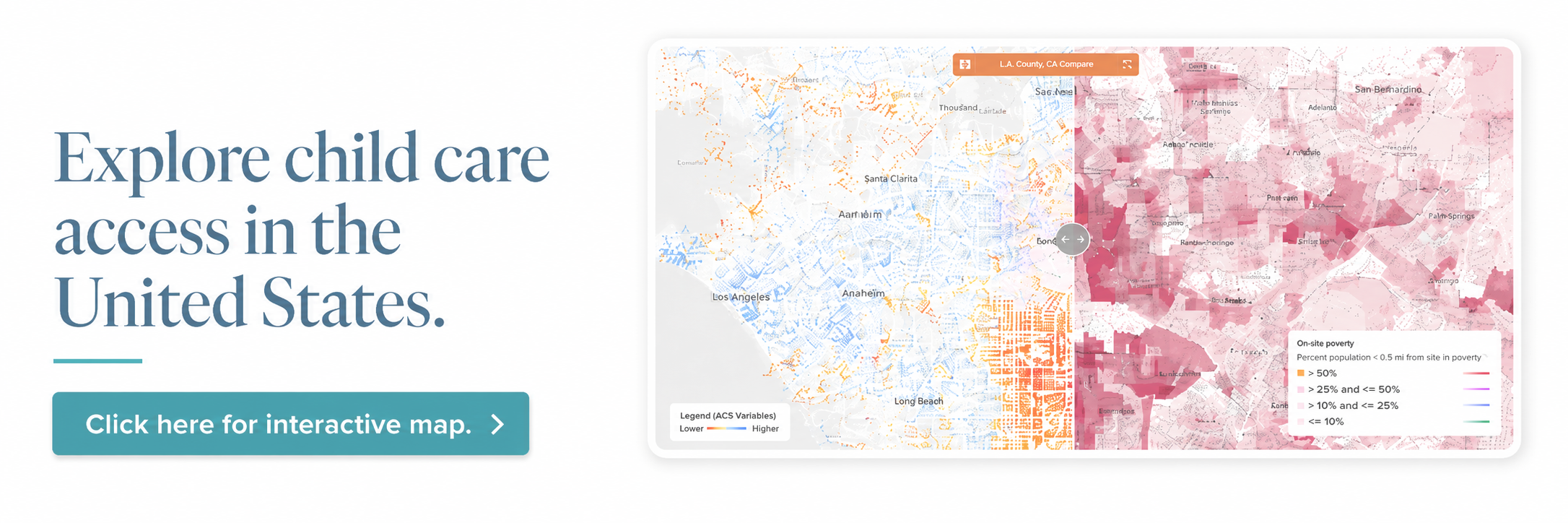
Recent research by a team of experts offers a more realistic picture of licensed child care availability by accounting for the options—and constraints—families encounter when looking for care.
The Upjohn Institute’s Gabrielle Pepin and Aaron Sojourner led the data collection and methodology, working with researchers at Stanford University and the Center for American Progress to produce interactive maps of child care access across the United States.
“Child care affordability is a well-documented issue for families nationwide,” the researchers write, “but even with expanded subsidies that would bring the cost of child care within reach, an insufficient supply of child care slots still fuels lengthy waitlists and leaves families with limited options.”
Mapping child care access more realistically
The researchers assembled provider-level data from state licensing systems, Head Start records, and public preschool programs from almost all 50 states and the District of Columbia via direct outreach, webscraping, and Freedom of Information Act requests, then standardized the information so child care supply could be compared between different communities and states. This intensive data collection effort is necessary because there is no unified federal data on providers, making it challenging to build a consistent picture of the issue across communities. As a check on data quality, the authors also validated each state’s administrative data against federal data sets that document similar information at a higher level of aggregation.
Rather than assuming parents look for child care only within the county or ZIP code in which they live as many prior analyses did, the researchers created overlapping service areas based on drive time from the homes of families with young children. They then compared the number of licensed child care slots within these areas with the number of nearby young children who may be competing for them. A child care provider straddling two adjacent counties, for example, is accessible to nearby families from both counties, effectively sharing its slots between them.
For each community, the researchers compared the estimated number of young children with the licensed capacity available within the surrounding service area. This comparison could identify “child care deserts,” defined as areas with more than three young children for every licensed child care slot.
The findings show that such shortages remain widespread: An estimated 46 percent of children under age 6 lived in a child care desert in 2025:
- Access was especially limited in rural America. About 70 percent of young children in remote rural areas (counties with fewer than 5,000 people) lived in child care deserts, up from roughly two-thirds in 2018.
- Majority-Hispanic/Latino communities had the highest average child care desert rate, at about 52 percent, significantly above the national average of nearly 46 percent.
- In majority-Black, non-Hispanic communities, about 35 percent of young children lived in child care deserts. This is the lowest desert rate of any group, likely due to a robust presence of Head Start and subsidized child care infrastructure in urban centers.
Why better measures matter
These data can help researchers and policymakers identify communities across the United States where child care supply is lacking relative to the number of local families with young children. That information can guide public investments, improve targeting efforts to expand capacity, and help communities track whether new programs are reaching places with the greatest need.
The analysis also reinforces an important point: The child care challenge is not only about affordability. Financial assistance can help families afford care, but subsidies alone cannot address the immediate challenge when there are too few nearby providers or limited capacity. Policies to improve child care access must address both the cost of care and the availability of child care slots.
By showing where licensed care exists, how much capacity is available, and how many families may be competing for it, the research can help communities move from broad concerns about child care shortages to more targeted and effective responses. It gives local communities data-driven tools to diagnose areas of shortage and prescribe targeted investments.
Experts

