

August 20, 2026
Economists and policymakers tend to focus on wages when they talk about jobs. That is understandable: money is important, and wages are relatively easy to measure. But a paycheck captures only part of what makes a job "good." Benefits, flexible hours, autonomy, work-life balance, opportunities for advancement, and whether the work itself is interesting or meaningful also matter to workers.
The effects of a strong labor market on pay are well documented. Far less is known about what happens to other dimensions of job quality when employers are competing more aggressively for workers. A new study by the Upjohn Institute’s Brad Hershbein and his coauthors examines that question.
Their results suggest that a tight labor market does more than push up wages: it also improves job quality. A 10 percent increase in a state’s job vacancies per resident increased the likelihood of a worker moving to an overall better job by about 11 percent, with similar gains across several other dimensions of job quality.
The researchers use data from the Federal Reserve’s Survey of Household Economics and Decisionmaking (SHED) to measure job characteristics. Since 2021, SHED has asked workers who changed jobs in the previous year whether their current job was better or worse in terms of pay and benefits, opportunities for advancement, interest in the work, work-life balance, physical demands, and overall job quality.
These data offer a picture of how job quality changed for workers—especially those taking a new job—over time. The researchers combine the SHED data with changes in local labor market conditions, measured using annualized job openings per state resident from the Bureau of Labor Statistics’ Job Openings and Labor Turnover Survey (JOLTS). By examining differences across states and changes within states over time, they can distinguish the effect of labor market strength from other factors that might influence job quality.
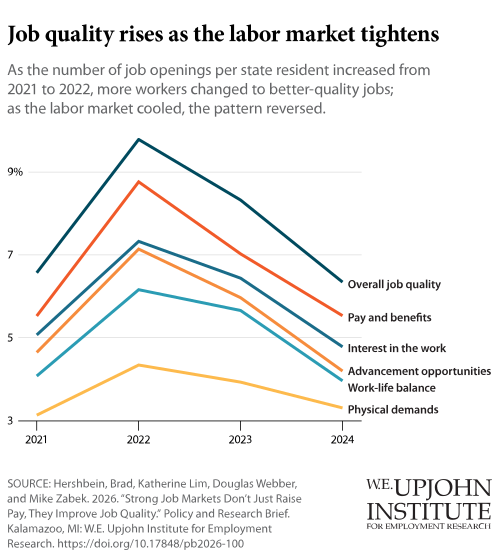
Dramatic changes in labor markets after the COVID-19 pandemic provide an unusual opportunity to study how changes in labor demand matter for job quality. Job openings per person rose sharply between 2021 and 2022 before weakening over the next 2 years. As the graph shows, the share of workers who “traded up” in terms of job quality likewise increased substantially across every dimension between 2021 and 2022, then declined as the labor market cooled.
The results point to several ways a strong labor market improves workers’ circumstances. A 10 percent increase in job openings per resident reduced the chances of being laid off by 4 percent and increased the chances of quitting by about 7 percent. It also made workers more likely to apply for and start a new job—and more likely to ask for and receive a raise even when they stayed with their current employer.
The findings demonstrate the importance of workers’ bargaining power. When employers are competing for workers, employees have more outside options. That gives them greater bargaining power, whether they use it to negotiate with their current employer or move to a new one. A 10 percent increase in job openings per resident raised the probability that a worker moved into a better overall job by about 11 percent, with similarly sized increases in the chance of moving to a job with better pay and benefits, more interesting work, more advancement opportunities, and better work-life balance.
Job switching accounted for much, but not all, of this improvement. About three-fifths of the increase in job quality came from the fact that stronger labor markets create more opportunities to switch jobs, and workers tend to find better jobs whenever they switch. The remaining two-fifths reflects that workers who change jobs in a stronger labor market are more likely to end up with a higher-quality job than workers who make a move in a weaker market.
The implications extend beyond the usual measures of labor market health. Policymakers often assess the labor market by looking at employment, unemployment, and wage growth. These measures are important, but they capture only part of the gains that workers experience when jobs are plentiful—and only part of what they lose when jobs are scarce. In other words, the social benefits of strong labor markets may be larger than economists and policymakers have traditionally recognized.
Experts
