

April 2, 2026
The migration corridor from Mexico to the United States is one of the largest in the world. While researchers have studied the effects of immigration on destination countries, less is known about how changing migration trends shape employment in migrants’ countries of origin.
Now a new paper by Gonzalo Ares de Parga-Regalado and Marta Prato, supported by the Upjohn Institute’s Early Career Research Awards, looks at how changes in immigration patterns from Mexico to the United States impact both wages and the types of jobs held by workers across local Mexican municipalities.
Using data from identification cards issued by Mexican consulates to their citizens living in the United States, which includes their municipality of origin and the U.S. county in which they live, along with economic data from Mexico’s Central Bank, the authors were able to explore the relationship between emigration rates and the economy in specific origin areas.
While changes in the rate of emigration from a local labor market in Mexico had little effect on overall employment rates, which were consistently high, there were changes in the balance between formal and informal employment. The authors found that a 1 percentage point decrease in the emigration rate from a local labor market led to a 1.45 percentage point increase in the share of workers in the formal sector for that local labor market. The formal sector includes documented employment reported to tax authorities and covered by labor protections, while the informal sector includes off-the-books jobs not covered by labor laws.
Falling emigration rates from a given area increase the labor supply there in the formal, private sector and put downward pressure on wages as those workers who remain in Mexico compete for formal-sector jobs. This suggests that those workers who otherwise would emigrate are those with higher skill levels and more job opportunities.
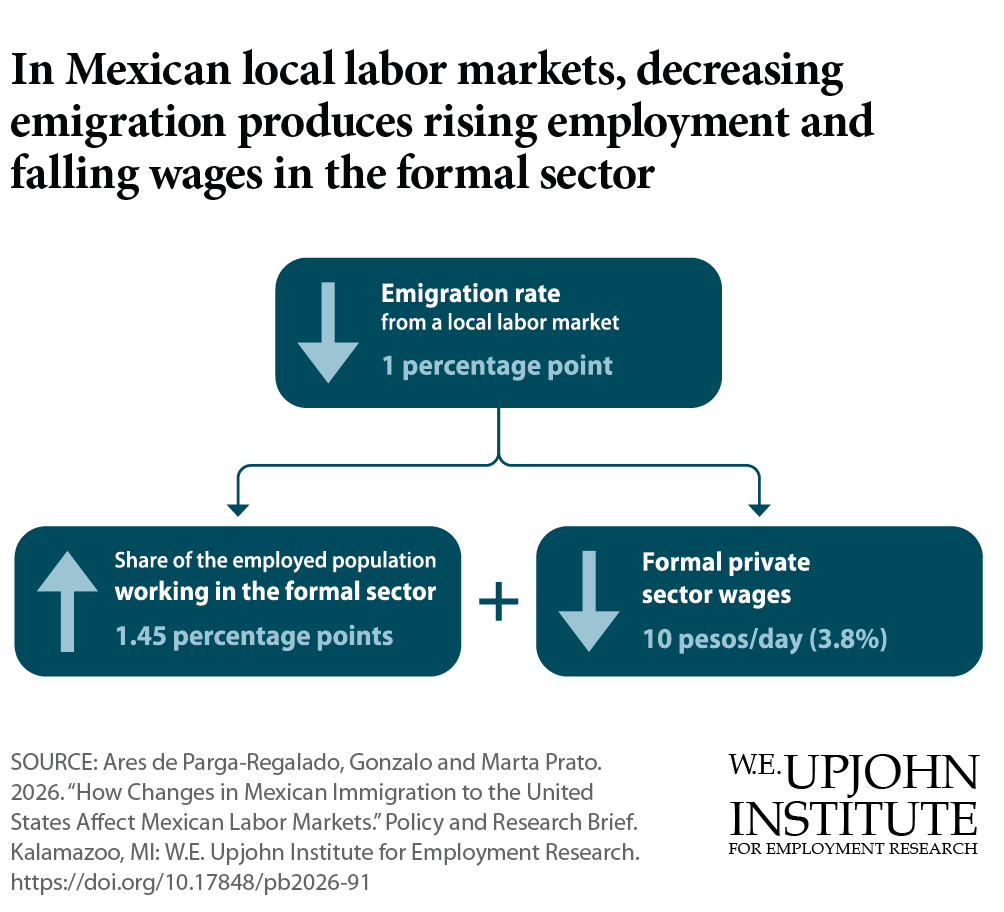
These results suggest that when the emigration rate falls, it most directly affects a certain kind of workers: ones who would otherwise be in the formal, private sector which tends to have higher pay and benefits than the informal sector.
If migration to the United States continues to decline, countries like Mexico may see more workers competing for formal-sector jobs and slower wage growth in those jobs, increasing the importance of policies that support the new labor market conditions. While reduced emigration may reduce formal-sector wages, a greater supply of more educated and higher-skilled workers may also create benefits for the local economy. Policies that inform businesses of the greater supply of local talent or provide assistance with entrepreneurial start-ups, for example, could help mitigate any negative impacts.
To learn more, check out the links to the paper and policy brief below